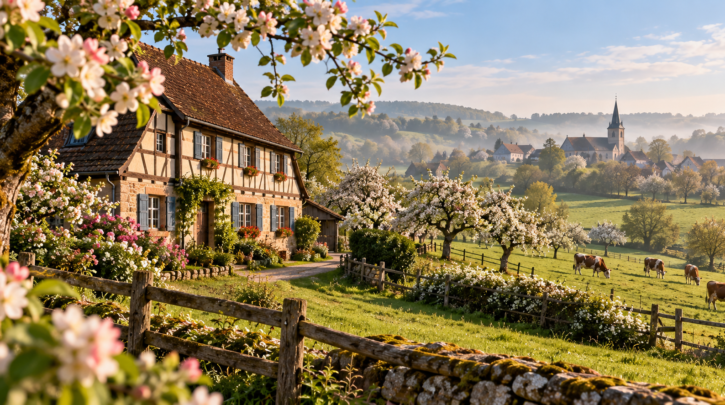

Normandy is one of the best-documented regions of France, and one of the easiest to research. Its parish and civil registers are extensive, its archives are well digitized, and its families appear in the early settlement of North America. This guide explains what to expect when your ancestors came from Normandy, and how to find them.
A short history that explains the records
Normandy takes its name from the Norsemen, or “Northmen,” who settled the area from the early tenth century, and the duchy that grew from that settlement became one of the most powerful in medieval Europe. Its Norse heritage left traces in place names and in some surnames, and its long Catholic tradition produced detailed parish registers. In 1944 the region became the site of the Allied landings and the Battle of Normandy, which devastated many towns and shaped twentieth-century records.
The five départements
| Département | Main towns | Notes for researchers |
|---|---|---|
| Calvados | Caen, Bayeux, Lisieux | Archives hold parish registers, including Protestant registers before 1792, and extensive online civil registers |
| Manche | Saint-Lô, Cherbourg | Peninsular département with a strong maritime tradition |
| Orne | Alençon | Rural; borders the Perche area linked to many early emigrants |
| Eure | Évreux | Close to Paris and Rouen; mixed influences |
| Seine-Maritime | Rouen, Le Havre, Dieppe | Includes Le Havre, the major port of French emigration |
For how provinces and départements fit together, see our guide to French regions.
Normandy records online
The Norman archives are among the better digitized in France. As one example, the archives of Calvados have published their parish registers, Protestant registers, and civil-registration indexes online, following the legal time limits for each type of record: roughly 100 years for births, 75 for marriages, 25 for deaths, and 75 for the ten-year indexes. Other départements follow similar rules but differ in how far they have digitized, so check each site. Our archives guide explains how to navigate them.
For twentieth-century research, some archives have published inventories of war-damage files (dommages de guerre), which list property owners compensated after 1944 and can add detail to a family’s story. Because the fighting damaged buildings and may have affected local collections, ask the département’s archives if a particular register is missing.
Surnames and place names
Norman surnames often reflect the countryside: names taken from villages (often ending in -ville, from the word for an estate), from occupations, and from nicknames. Some names preserve Norse roots, such as Anquetil. Many Norman place names also show Norse influence. Because Normandy was settled early and consistently, many families can be traced for centuries within the same few communes.
The link to North America
Many early settlers of New France came from Normandy and nearby areas such as Perche and the Atlantic ports of the west, which is one reason Norman surnames are common in Quebec and Acadia. If your Norman ancestors may have crossed in the 1600s, our sister site French Canadian Roots explains the colonial records. For later emigrants, Le Havre was the main port of departure, and our guide to French emigration to America tells the wider story.
A practical approach
- Confirm the commune and département from your North American records.
- Search the civil registers from 1792 using the ten-year indexes, then move to the parish registers.
- If the commune is uncertain, search a name index such as the one on MyHeritage across Normandy’s communes.
- Check Protestant registers if your family was Reformed. Normandy had Protestant communities in several towns.
- For the twentieth century, add war-damage and other administrative files where they exist.
Illustrative composite (not a real family): A researcher in Maine has an ancestor from a village near Bayeux. Using the Calvados archives, he finds the civil birth act, follows the marriage back to the parish registers of the 1700s, and spots a godfather with a surname that appears in a nearby village, leading him to the next generation.
For the research method in full, see our complete guide to tracing French ancestry.
Protestant Normandy
Not all Normans were Catholic. Reformed Protestant communities existed in several towns, including Rouen, Dieppe, and Caen, and the Calvados archives hold Protestant registers dating from before 1792. After the revocation of the Edict of Nantes in 1685, many Norman Protestants emigrated or converted outwardly. If your family disappears from Catholic registers and reappears abroad, read our Huguenot ancestry guide.
Ports and passage
Le Havre, in Seine-Maritime, was the principal port from which French emigrants left for the Americas in the nineteenth century, and Rouen and Dieppe were also active ports. A family’s journey may therefore begin far from the family’s home commune, and an ancestor sailing from Le Havre did not necessarily come from Normandy. Treat the port as a step in the story, not the answer to “where did they come from.”
Notarial records and other sources
Once you have the family in the registers, notarial acts, such as marriage contracts, wills, and inventories, can add property, occupations, and family relationships that vital records omit. They are held by the departmental archives and are often catalogued by notary and commune, so ask the archives how to search them for your ancestor’s commune.
Common questions about Norman research
- Are Norman records better than elsewhere? Often, yes, since the registers are extensive and well digitized, though quality still varies by commune.
- Does a Norman surname prove Viking ancestry? No. A few surnames have Norse roots, but most Norman names are ordinary French names. DNA estimates are the wrong tool for this.
- Were my ancestors among the settlers of Quebec? Possibly, if they left in the 1600s. See French Canadian Roots for the colonial records.
Check the neighboring communes
Rural Normandy is a patchwork of small communes, and families crossed commune boundaries easily for work and marriage. If an ancestor’s baptism is not in the commune you expect, widen the search to the adjacent parishes, and check the marriage in the bride’s commune. Many Norman researchers find the missing record one village over.
French Roots is reader-supported. Some links on this page are affiliate links, which means we may earn a commission if you sign up, at no extra cost to you. Read our affiliate disclosure.