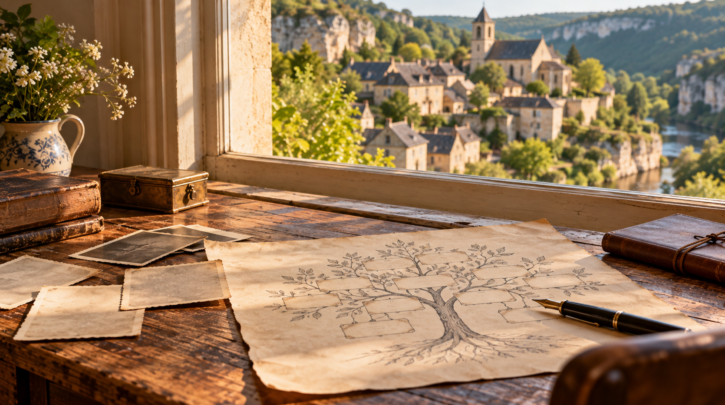

Tracing French ancestry has a reputation for being difficult, and the first half of that reputation is deserved. The second half, that the records are hard to find or hard to use, is not. France has kept civil registers since 1792 and parish registers for centuries before that, most of them survive, and a large share are free to view online. The real obstacle is the Atlantic Ocean. This guide walks you through the whole journey, from the first conversation with a relative to a named ancestor in a French village, and shows which tool fits each step.
Step 1: Build your tree on this side of the Atlantic
Every French research project begins at home. Write down everything you know about yourself, your parents, and your grandparents, then work backward one generation at a time using the records of the country where your family settled: birth, marriage, and death certificates, census returns, city directories, military records, and obituaries. Confirm each parent–child link in a document before you move on. It is tempting to leap to a famous surname or a family legend, but a tree built on unverified links will lead you to the wrong French family, and the French records will not warn you.
If you have not started yet, our French Ancestry Starter Kit sets out this process in seven steps.
Step 2: Find the commune your ancestor came from
This is the keystone step, and the one that stalls most researchers. French records are organized by commune (the town or village) and département (the administrative region whose archives hold the registers). Without a commune, you are searching a country of tens of thousands of communes for a surname. With one, the registers open up. The commune name usually hides in records created where the family settled: naturalization papers, passenger lists, draft registrations, church records, and passport applications. We cover every source in detail in our guide to finding your ancestor’s commune of origin in France.
Step 3: Understand how French records are organized
Three ideas explain almost everything about where French records live:
- Records are local. A birth is registered in the commune where it happened, so you search by place first and name second.
- Two systems, divided at 1792. Before 1792, the Catholic Church kept the registers. From 1792 onward, the state did, through civil registration (état civil).
- The archives hold the originals. The departmental archives (Archives départementales) hold the registers for every commune in the département, and most publish them online.
Step 4: Start with état civil, 1792 to about 1920
Civil registration is where nearly every French search should begin, because it is the easiest and most informative record set. Each commune recorded births, marriages, and deaths in annual registers, with a ten-year index (table décennale) that makes a name easy to find once you know the commune. A marriage act typically names both spouses, their ages, occupations, and residences, their parents, and the witnesses, and often notes the parents’ consent and whether the parents were living. That is why the marriage record is the most valuable single document in French research. Our guide to French état civil records explains what each act contains, the 75-year access rule, and how to request a copy.
Step 5: Go further back with parish registers
Before 1792, your ancestors appear in the baptism, marriage, and burial registers of their parish. Royal ordinances from the sixteenth century onward required parishes to keep them, and from 1667 they were kept in duplicate, which is one reason so many survive. Early registers can be brief and hard to read, but by the eighteenth century they are often rich. Read more in our guide to French parish registers before 1792.
Step 6: Add the supporting records
Once you have the core lines, other records add color and break brick walls: recensements (census lists), registres matricules (military recruitment registers with physical descriptions), and minutes notariales (notarial acts such as marriage contracts, wills, and property inventories, which reveal relationships that vital records omit). Our French genealogy records hub summarizes each of these and where to find them.
Step 7: Choose where to search
No single website has everything, and the right choice depends on what you already know. Here is the short version; the long version is in our comparison of MyHeritage, Geneanet, and other French genealogy sites.
- MyHeritage is the tool we recommend first for most people. It owns Filae, one of France’s leading genealogy companies, and offers a name index and images across French civil and church records, plus family trees and DNA matching. Searching is free; viewing images requires a subscription.
- The departmental archives are free and authoritative. They are the best choice when you already know the commune and approximate year, and they are covered in our beginner’s guide to the archives online.
- FamilySearch is free and has indexed many French collections. Its FamilySearch Research Wiki on France is also an excellent place to learn what exists for a particular area.
- Geneanet is strongest for French-language family trees and for contacting French researchers who share your lines.
Step 8: Learn to read the records
You do not need to be fluent in French. Acts follow predictable formulas, and a short vocabulary list unlocks most of what you need. Watch for two traps: women are recorded under their maiden names throughout their lives, and the Republican calendar replaced months and years in records between 1793 and 1805. Our guide to reading old French records has vocabulary, a calendar conversion table, and handwriting tips.
Use DNA to find cousins and test your tree
DNA cannot name your ancestor’s commune, but it can connect you to living cousins who descend from the same French families, and it can confirm or challenge lines you have documented. Two points matter for French research. First, genealogical DNA testing is currently illegal in France, so the pool of French matches is thinner than in other countries, though well over 100,000 French people are estimated to test through foreign companies every year. Second, matches are clues, not proof; always confirm a connection in the records. See our DNA guide for French ancestry.
If you hope to prove French nationality
A documented line of descent is also the foundation of any claim to French nationality, which passes by descent from a French parent. It is something you prove rather than apply for, and strict rules apply. Read the citizenship guide before you spend money on documents.
Common mistakes to avoid
- Searching for a surname instead of a place. In France, the commune and year are what find the record.
- Trusting an online tree without checking the original act. Many trees copy each other’s errors.
- Forgetting spelling variants, accents, and hyphenated or abbreviated given names.
- Skipping the siblings. Brothers and sisters often appear in records that your direct ancestor does not.
- Assuming “French” means France. Families from Alsace-Lorraine, for example, may have records in German for part of the nineteenth and twentieth centuries.
A research plan you can start today
- Interview your oldest relatives and write down names, dates, and places.
- Trace your line backward in your own country until you reach the immigrant.
- Find the commune in naturalization, passenger, draft, or church records.
- Locate the commune on a map and identify its département.
- Search the civil registers for the immigrant’s birth or marriage and read the marriage act for parents’ names.
- Move backward through the parish registers one generation at a time.
- Cite every source, and add DNA matches as a cross-check.
Illustrative composite (not a real family): A researcher in Ohio knows her great-grandfather “came from France” around 1900. His naturalization petition names a village in the Vosges. She finds the village on the departmental archives site, locates his birth in the civil register, reads the names of his parents and witnesses, and within an evening has two more generations. Months of work on this side of the ocean made an evening of work on the other side.
For authoritative background on what survives and where, consult the FranceArchives national portal and the FamilySearch Research Wiki on France. The journey is longer than a single search, but every step is documented, and the records are generous to those who take them in order.
When the trail goes cold: brick-wall strategies
Every French line hits a wall eventually. The good news is that France’s records give you many ways around it, and most of them involve people other than your direct ancestor.
- Siblings. A brother’s marriage act may name parents your ancestor’s own record omits, or give a more complete birthplace.
- Godparents and witnesses. They were usually relatives or close neighbors. A witness who shares a surname with a bride’s mother is probably an uncle, and that is a lead.
- Notarial acts. Marriage contracts, wills, and inventories can name relationships that vital records leave out, including half-siblings and deceased parents.
- Neighboring communes. People married in the bride’s parish and were sometimes baptized in a neighboring village. If a record is missing, widen the circle.
- Different spellings. Search by sound, drop accents, and try regional variants of the surname.
How long does French research take?
Expect the American or Canadian half of the work, finding the commune, to take the longest, sometimes months. Once you have a commune and a year, the French half often moves quickly, because the registers are continuous and well indexed. Many researchers add several generations in a single weekend once they are in the right village. Keep notes as you go, citing the register, the page or image number, and the date you consulted it, so you never have to repeat a search.
French Roots is reader-supported. Some links on this page are affiliate links, which means we may earn a commission if you sign up, at no extra cost to you. Read our affiliate disclosure.