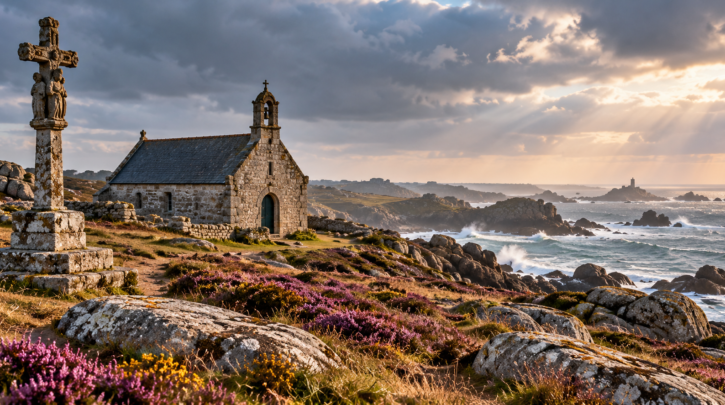

Brittany sits at the western tip of France, and it has always felt slightly apart from the rest of the country. A Celtic language, a strong Catholic tradition, a long Atlantic coastline, and a set of surnames that looks nothing like those of Paris or Provence make Breton ancestry easy to recognize and rewarding to research. This guide explains how to find and read the records of your Breton ancestors.
Where Brittany is on the map
Modern Brittany comprises four départements: Finistère, Côtes-d’Armor, Morbihan, and Ille-et-Vilaine. The historic province also included Loire-Atlantique, which is now administered with the Pays de la Loire region, so if your ancestor is “from Nantes” you may need to look in Loire-Atlantique’s archives rather than Brittany’s. See our guide to French regions for how provinces and départements relate.
Two Brittanys: language and records
Western, or Lower, Brittany was historically Breton-speaking, while eastern, or Upper, Brittany spoke French and local dialects. This matters for research because civil and parish records were written in French (and Latin earlier), even when the people in front of the clerk spoke Breton. Names were spelled as a French-speaking clerk heard them, so a single Breton name can appear in several forms, and the spelling in one record may differ noticeably from the next. Search by sound and try variants.
Breton surnames and what they mean
Breton surnames are among the most recognizable in France, and many have a clear meaning:
| Pattern or name | Typical meaning or origin |
|---|---|
| Le Goff | the smith |
| Le Gall | from a word relating to the Gauls or to a foreign origin |
| Le Roux | the red-haired one |
| Le Bihan | the small one |
| Le Bras | the big one |
| Ker- names (for example, Kervella) | from ker, meaning a village or farmstead |
| Pen- and Tre- names | from words meaning “head” or “end” and “settlement,” often tied to a place |
The article Le is not a sign of nobility; it simply means “the.” Because a relatively small number of surnames were shared by very large numbers of people, identifying the right individual requires care. Two men of the same name in the same parish were common, so confirm identity with dates, spouses, and godparents.
Records and where to find them
- The departmental archives for Finistère, Côtes-d’Armor, Morbihan, Ille-et-Vilaine, and Loire-Atlantique hold the civil and parish registers. Most publish them online. Follow our archives guide.
- Civil registers from 1792 and parish registers before that, as explained in our guides to état civil and parish registers.
- Name indexes. If you do not know the commune, MyHeritage and Geneanet offer name indexes for many French collections. Compare them in our comparison guide.
- Local and regional genealogical societies often publish transcriptions and surname studies. The FamilySearch Research Wiki on France lists resources by region.
Patterns of work and migration
Brittany’s long coastline shaped its economy. Many Breton men worked in coastal fishing and trade, and fishermen from ports such as Saint-Malo sailed to the Newfoundland cod fishery, so a Breton ancestor may appear in maritime records as well as parish registers. In the nineteenth and twentieth centuries many Bretons moved to Paris and other cities for work. If a family seems to vanish from its commune, check the civil registers of larger towns and Paris.
Practical tips for Breton research
- Use the whole family. Because names repeat, trace siblings and spouses to separate people who share a name.
- Look for the farm or hamlet. Breton records often name a lieu-dit (hamlet) or farm, which can distinguish families in the same parish.
- Expect spelling drift. Compare several records before deciding how a name was “really” spelled.
- Check Loire-Atlantique if your ancestor is from the Nantes area or the southern edge of historic Brittany.
Illustrative composite (not a real family): A researcher in Louisiana knows her ancestor was a fisherman named Le Gall from Finistère. Using the marriage act, she identifies his parents and the hamlet where they farmed, and sorts him from three other Le Galls in the same parish by their wives’ names and the godparents at their children’s baptisms.
For the full research method, see our complete guide to tracing French ancestry.
Given names and naming customs in Brittany
Breton given names reflect the region’s saints. Many of Brittany’s towns are named after early saints, such as Saint-Malo and Saint-Brieuc, and the names Yves, Corentin, Gildas, Malo, and Brieuc appear again and again in the registers. Compound names such as Jean-Marie and Marie-Anne were common, and children were often named after godparents and grandparents, so the same combination can recur in several generations. When two people have the same name, distinguishing them by dates and spouses is essential.
The Revolution and the Chouannerie
Brittany was a center of resistance to the Revolution in the 1790s, and the counter-revolutionary uprising known as the Chouannerie disrupted life across the west. If a family’s trail wavers in the 1790s, remember that registers of that decade can be incomplete, and look for the same people in later civil records and in notarial acts.
Common questions about Breton research
- Does the name “Le” mean my family was noble? No. It simply means “the,” and is attached to common Breton surnames of every rank.
- Why are there so many people with the same surname? A small number of surnames were shared by very large numbers of people, so confirm identity through dates, spouses, and godparents.
- My ancestor’s record is in Latin or French. Where is the Breton? Records were written in French and Latin, not Breton, though the people were often Breton speakers. The Breton shows up in the spelling of names.
- Where do I find a name if I do not know the commune? Use a name index such as MyHeritage, then confirm in the archives.
French Roots is reader-supported. Some links on this page are affiliate links, which means we may earn a commission if you sign up, at no extra cost to you. Read our affiliate disclosure.