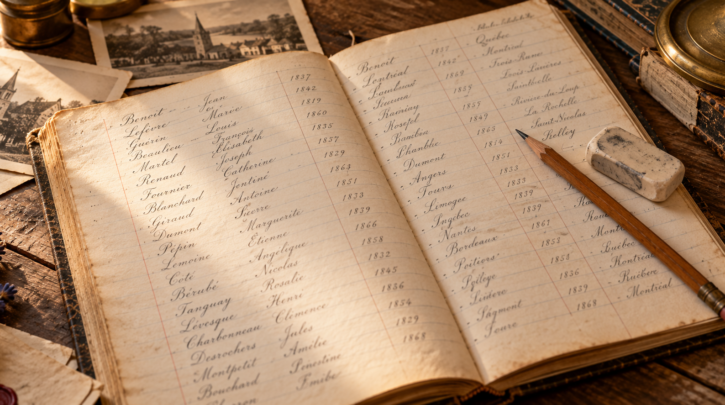

If you cannot find your French ancestor under the name you know, the problem is often not the person but the spelling. French surnames appear in many forms across the records, and a search that insists on one spelling will miss relatives sitting in plain sight. This guide explains why surnames vary and how to search for them.
Why one name appears in many forms
- Names were heard, not read. Most people could not write, and clerks and priests spelled names as they heard them.
- Regional pronunciation. The same name could sound different in Brittany, Alsace, or Provence, and be written accordingly.
- Accents were optional. Many old records omit accents, and online indexes often drop them.
- Latin and regional forms. Older parish registers may use Latinized forms of names, and records in regions with another language may give local spellings.
- Standardization came slowly. After civil registration began in 1792, and the law of 1794 fixed the name in the birth act, spelling became more stable, but variation did not disappear.
Common kinds of variation
| Kind | Example variants |
|---|---|
| One name, regional forms | Lefebvre, Lefèvre, Le Febvre, Lefébure, Favre, Faivre |
| y and i | Henry and Henri; Dupuy, Dupuis, Dupuits |
| Silent final letters | Durand and Durant; Thibault, Thibaut, and Thibeau |
| Particles joined or split | Dupont, Du Pont, du Pont; Delacroix and De La Croix |
| Accents and apostrophes | Lévesque and Levesque; D’Aoust and Daoust |
| Doubled consonants | Lefebvre and Lefèbvre; Perrot and Perot |
The smith’s name is the classic case: Lefebvre is the leading surname in the north of France, while Favre and Faivre are forms found in the east, all from the same Latin root. See our guide to surname meanings.
Particles, articles, and hyphens
The elements Le, La, De, Du, and Des are part of the surname, but indexes treat them inconsistently. Lefebvre may be filed under L, under F as “Febvre, Le,” or as two words. When you search, try the name joined, separated, and without the prefix, and look under both letters in alphabetical indexes such as the tables décennales. Hyphens appear in compound names and in given names (Jean-Baptiste), and indexes may drop them.
Accents in the records and in search
Do not rely on accents. Search both with and without them, and remember that your keyboard’s version of a name may not match the index. If a search on “Lévesque” finds nothing, try “Levesque,” and vice versa.
Regional and foreign influences
- Brittany: Breton names were written by French-speaking clerks, so spellings vary within a single family. See our Breton ancestry guide.
- Alsace and Lorraine: Names may appear in French or German form, such as Schmitt and Schmidt. See our Alsace-Lorraine guide.
- The north: Flemish and Picard influences produce spellings such as Leclercq with a final “q.”
- Immigrant families: Spellings changed again when families moved abroad, as we explain in our guide to anglicized French surnames.
Practical search strategies
- Make a variant list for your surname and add every spelling you find in any record.
- Use the search options. Major sites, including MyHeritage and Geneanet, offer ways to include similar names and alternate spellings. Turn them on.
- Try the sound, not the spelling. Say the name aloud and imagine how a clerk would write it. Sound-based search tools built for English can miss French patterns, so test several spellings by hand.
- Search first names too. Given names vary as much as surnames: Jean may appear as Jehan or Jan, and compound names such as Jean-Baptiste may be split.
- Search by place and date instead of by name when you know the commune. Open the register and read the entries yourself.
- Use relatives. A sibling or child may be indexed under a spelling you have not tried. Check them all.
Which spelling is “correct”?
There is rarely a single right answer. After 1794 the spelling in the birth act is the legal form, but the same person may be written differently in other documents. For genealogy, record the form in each document exactly as written, then choose a standard spelling for your tree and note the variants beside it.
Illustrative composite (not a real family): A researcher cannot find her ancestor Thibault in the civil index for his commune. Trying Thibaut, Thibeau, and Thibaud, she finds his marriage under Thibeau, and the entry names his parents under yet another spelling. All the variants belonged to one family.
For the broader method, see our complete guide to French surname origins and our guide to tracing French ancestry.
A cheat sheet of common substitutions
Clerks tended to make the same kinds of substitutions again and again. When you cannot find a name, try swapping these:
- c, k, and qu (Lecoq, Lekoq), and s and z or x.
- au, eau, and o (Moreau, Moreaux, Moro) and ai, e, and é (Lefèvre, Lefevre).
- y, i, and ie (Henry, Henri), and ph and f.
- th and t (Thibault, Tibaut), and ch and sh in names from Flemish or German sources.
- Single and double consonants (Perot, Perrot), and silent endings in -s, -x, -d, and -t.
A worked example: Lévesque
Suppose your ancestor’s name is Lévesque, from the word for “bishop.” In different records you might find L’Évêque, Lévêque, Levesque, Lesvesque, and Levêque. A clerk who did not know the word wrote what he heard, while one who did wrote the formal spelling. A search for only one form would find perhaps a third of the family. Searching all five, and checking the commune’s index page by page, finds them all.
Given names vary too
Do not forget that first names change as much as surnames. Jean may appear as Jehan, Marie as Marye, and Françoise without its cedilla. Compound given names such as Jean-Baptiste may be split or joined, and a man known as Jean-Pierre in one record may be Pierre in another. The FamilySearch Research Wiki on France lists name variants and common abbreviations for French records.
French Roots is reader-supported. Some links on this page are affiliate links, which means we may earn a commission if you sign up, at no extra cost to you. Read our affiliate disclosure.