
A French surname is a small piece of history that your family has carried for centuries. It may record a medieval trade, a hillside, a saint’s day, a physical trait, or the name of a long-forgotten ancestor, and it often points to the region your family came from. It can also mislead: surnames drift in spelling, collect folk explanations, and change meaning over time. This guide explains when and why French surnames arose, the main kinds, how the law fixed them, and how to research your own name without falling for the myths.
When French surnames began
Surnames appeared in France gradually, from around the eleventh and twelfth centuries, as growing populations made a single given name inadequate. If a village had several men named Martin, people added a second name to tell them apart: a father’s name, a trade, a place, or a nickname. At first these second names were personal and could change from one generation to the next. Over the following centuries they became hereditary, and from the fifteenth century a long process of fixing names began.
Three milestones are worth knowing. According to genealogical sources, Louis XI forbade changing one’s name without royal authorization in 1474. The royal ordinance of Villers-Cotterêts in 1539 required parish registers, which helped to stabilize spelling. And the law of 6 Fructidor, Year II (August 23, 1794) forbade any citizen to bear a name or forename other than the one in his birth act. The same law also forbade adding a surname to one’s own name, unless it had long served to distinguish branches of a family and did not recall feudal or noble ties. That exception helps explain why some families kept a second name, a topic we cover in our later guide to dit names.
The main types of French surnames
| Type | How it arose | Examples |
|---|---|---|
| Given-name (patronymic) | A father’s or ancestor’s first name became the family name | Martin, Bernard, Robert, Thomas, Richard |
| Occupational | A trade or role | Boulanger (baker), Meunier (miller), Lefèvre (smith), Berger (shepherd) |
| Place or residence | Where a person lived or came from | Dupont, Dubois, Dumont, Delacroix, Lafontaine |
| Regional or ethnic origin | A person’s homeland, as seen from elsewhere | Lebreton, Lenormand, Picard, Langlois, Lallemand |
| Nickname | A physical trait or character | Petit, Legrand, Leroux, Lenoir, Lesage |
A great many French surnames began as given names. By one estimate, more than 40 percent of French people bear a given name as a surname, and many of those names are of Germanic origin, reflecting the influence of the Franks: Charles, Gérard, Guillaume, Louis, and Thierry are all Germanic in origin. For detailed meanings by type, see our guide to French surname meanings.
How many French surnames are there?
France has more than a million different surnames, which is unusually many for a single country, and the distribution is very uneven. According to Geneanet figures reported in the regional press, half of French surnames are borne by fewer than ten people, 5 percent of surnames cover 80 percent of the population, and about 1,000 names account for a quarter of all French people. Martin tops almost every ranking. Our guide to the most common French surnames looks at the leaders and what they mean.
Why your surname may vary in the records
The same surname can appear in many forms, because clerks wrote what they heard, regions pronounced names differently, accents were often omitted, and an old register may use a Latin or regional form. A spelling that looks wrong is often just a variant, and knowing the common variants is essential to finding your ancestors. We cover this in French surname spelling variants.
Surnames and regions
Many French surnames point to a region. Breton names, Basque names, Alsatian names, and Flemish-influenced names of the north all have distinctive patterns, and a surname that is common in one département may be rare elsewhere. The leading name in the Nord is Lefebvre, for example, while Besson tops the Rhône and Bernard leads the Gironde. See our guide to regional French surnames and our guide to French regions.
Surnames in the records of other countries
If your ancestors emigrated, their surname may have changed spelling or even been translated into English. The popular explanation, that officials changed names at Ellis Island, is a myth, and the real story is more interesting. Read how French surnames changed in America.
Naming customs and the law today
In France, spouses keep their birth names, and civil records list women under their maiden names for life. Under reforms in the early 2000s and a later law on the choice of name, parents may choose the father’s name, the mother’s name, or both for a child. Changing a surname requires a legitimate reason. These rules matter to genealogists because, since the 1790s, the name in the birth act is the legal name.
Is “de” a sign of nobility?
No. The particle “de” simply means “of” or “from,” and it appears in the names of many commoners, such as families named after a place. A surname with “de” is not evidence of noble descent, and nobility is proven through documents, not spelling.
What about family crests?
Be wary of companies that sell a “family crest” or “coat of arms” for your surname. Arms belonged to specific individuals and their descendants, not to everyone sharing a name, so a crest sold by surname has no genealogical value. If you believe your family held arms, look for proof in records.
How to research your surname
- Confirm the spelling in documents as your ancestors wrote or signed it, and note all variants.
- Map where the name is concentrated. French genealogy sites offer surname-distribution tools showing where a name has been found over several centuries.
- Check reference works. Standard etymological dictionaries of French surnames, such as Albert Dauzat’s, and online resources like Geneawiki’s article on onomastics explain origins, though they differ on some names.
- Beware folk etymology. A name that seems to mean something in modern French may have meant something quite different in the Middle Ages.
- Let the records decide. Trace the family back to a commune and confirm the name in the registers. See our complete guide to tracing French ancestry.
- Use a name index. A service such as MyHeritage, with its French records from Filae, lets you search a surname across communes. Compare options in our guide to French genealogy sites.
Illustrative composite (not a real family): A family in Illinois has the surname Lefebvre and a family story that it means “the king’s smith.” Checking a surname dictionary and the records, they learn that Lefebvre simply means “the smith,” from the Latin faber, that it is the leading name in the north of France, and that their ancestors came from a village near Lille. The story was charming but the evidence was better.
For the broader research method, see our complete guide to tracing French ancestry, and for the records that hold your name, our état civil guide.
Surname myths to avoid
- “My name is unique to my family.” Even rare surnames usually have several unrelated origins, and a name shared by two families may have arisen twice.
- “The meaning in modern French is the original meaning.” Words change. A name that looks like a modern French word may preserve a medieval sense, a dialect word, or a personal name that merely sounds similar.
- “A grand-sounding name means noble ancestors.” Names like Leroy (the king) or Lecomte (the count) were nicknames or servants’ names far more often than titles.
- “There is one correct spelling.” Before the nineteenth century there was none, and even later the same person may be written several ways.
- “A surname proves where my ancestors lived.” It is a clue, not proof. Families moved, and many names are common across the country.
Reading a name in a record
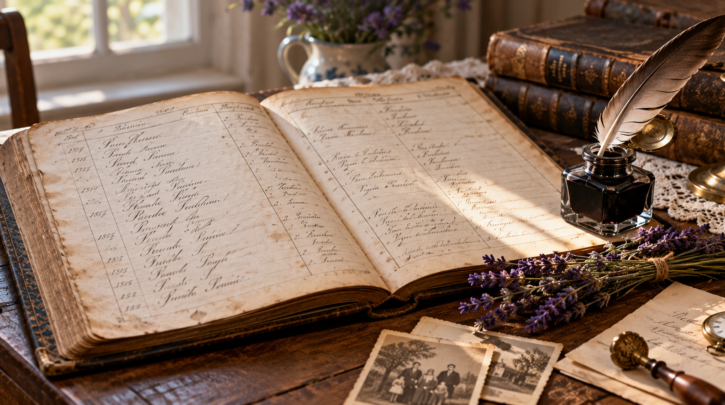
In modern French civil records and archive indexes, the surname is usually written in capital letters and the given names follow, as in DUPONT Jean-Baptiste. Women are listed under their maiden names, and compound given names (Marie-Anne, Jean-Pierre) are common and often hyphenated. Old parish registers are less tidy: the surname may be written in lowercase, abbreviated, or attached to a nickname. Learn to spot where the given name ends and the surname begins before you search.
Your first week of surname research
- List every spelling of the name found in your family’s own documents.
- Look up the name in a distribution tool and note the leading départements.
- Read two or three dictionary or wiki entries and compare their explanations.
- Search a name index for the surname within the département the tool suggests, as in our guide to the archives.
- Open the registers for one commune and look for the name yourself.
Frequently asked questions
- Does my surname tell me my ethnicity? It suggests a region or language, not an ethnic identity. For ancestry estimates, see our DNA guide.
- Can I change my French surname? Only for a legitimate reason, under French law. For your genealogy, however, the name in the birth act is what counts.
- Why do two brothers have different spellings? Because spelling was not fixed, and different clerks wrote the family’s name differently.
- Where can I read more? The FamilySearch Research Wiki on France lists resources by region and topic.
French Roots is reader-supported. Some links on this page are affiliate links, which means we may earn a commission if you sign up, at no extra cost to you. Read our affiliate disclosure.