
If your family came from France, MyHeritage DNA is the test we suggest looking at first. That recommendation comes with reasons, and with limits, which we set out here. This review is written for readers outside France and focuses on what MyHeritage offers someone researching French ancestry.
What MyHeritage DNA is
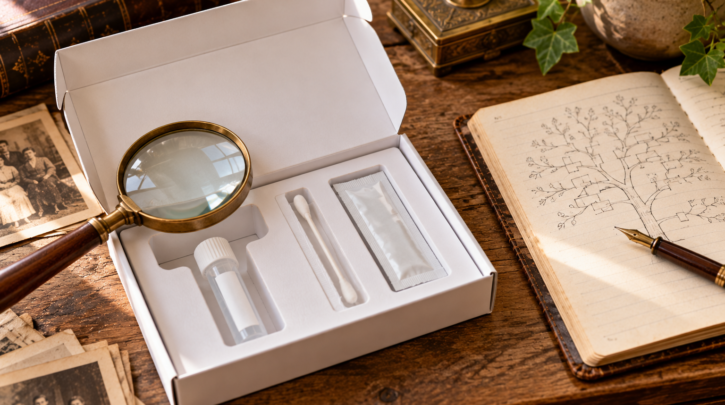
MyHeritage DNA is an autosomal DNA test: a saliva sample is analyzed, and the results are compared with other users to find relatives and to estimate ethnic origins. It sits inside MyHeritage’s wider genealogy platform, which combines family trees, historical records, and DNA matching in one account.
Why it suits French research
- Strength in Europe. An independent database tracker reports 9.6 million MyHeritage kits available for matching and calls it probably the best bet for people living in continental Europe.
- French records in the same account. MyHeritage acquired Filae, one of France’s leading genealogy companies, in 2021, and offers French civil and church records alongside your matches. Searching is free; viewing record images requires a subscription.
- Free uploads. You can upload DNA data from other companies at no charge, so a test taken elsewhere can still reach MyHeritage’s pool of matches.
- A chromosome browser. You can see where you share DNA with a match, which makes matches easier to interpret and verify.
- Tools that organize matches. Features that cluster matches into family groups and suggest how a match connects to your tree save hours of manual work. Some advanced tools require a subscription.
Honest limits
- It is smaller than AncestryDNA. AncestryDNA has about 30 million kits to MyHeritage’s 9.6 million, so for North American cousins Ancestry’s pool is larger.
- French cousins are still fewer than you might hope. Genealogical DNA testing is illegal in France, and MyHeritage no longer ships kits to French addresses, so the pool of French matches is thinner than in other countries.
- Some features cost extra. Record images and certain match tools sit behind a subscription. Check what is included before you pay.
- Records overlap with the free archives. The record images are largely those the departmental archives publish free, so what you pay for is the name index and tools. See our comparison of French genealogy sites.
- Privacy deserves thought. French consumer groups have criticized how DNA companies explain what happens to samples and data. Read the privacy policy, decide on research opt-ins, and learn how to delete your data.
MyHeritage DNA or AncestryDNA?
| Question | MyHeritage DNA | AncestryDNA |
|---|---|---|
| Database size (March 2026) | 9.6 million kits available for matching | About 30 million kits |
| Strongest region | Europe, including France | North America |
| Chromosome browser | Yes | No |
| French records in the same account | Yes, via Filae | Some French collections; stronger for North American records |
| Free upload of data from other companies | Yes | No |
| Ships kits to France | No | No |
You do not have to choose. Many researchers test at AncestryDNA for the large North American pool and upload the data free to MyHeritage for its European reach and tools. See the full comparison in our best DNA test for French ancestry.
How to get the most from MyHeritage DNA
- Build a tree first. Even a small tree lets MyHeritage suggest record matches and connections.
- Test, or upload existing data from another company.
- Sort matches by shared DNA and by the longest segment, and look at the match’s tree.
- Look for French surnames and places that you recognize. See our surname guide.
- Use the chromosome browser and clustering tools to group matches by family line.
- Confirm every connection in the records. See our guide to connecting matches to French records.
Who should choose MyHeritage DNA
- People with French lines who want French records and DNA in one place.
- People who already tested elsewhere and want free access to a second pool.
- People who want a chromosome browser and clustering tools without paying for a second test.
It may be a weaker choice if your only goal is the largest possible number of North American cousins, where AncestryDNA leads.
Illustrative composite (not a real family): A researcher in Ohio tests at AncestryDNA, uploads the data to MyHeritage, and sees a cluster of matches with trees in the Vosges. A record match links one cousin’s tree to a French marriage act, and she confirms the shared ancestor in the departmental archives.
For the broader picture, see the DNA hub and our complete guide to tracing French ancestry.
Questions about MyHeritage DNA
- Can I upload data from AncestryDNA or 23andMe? Data from the major companies can generally be uploaded free, though you should check the supported file formats before you begin.
- Will it find French cousins? It can, but the pool of French testers is thinner than elsewhere because of the French ban. Many French matches are descendants of emigrants living abroad.
- Is it worth it if I already tested elsewhere? Often yes, because the free upload costs nothing and reaches a different set of people. See our comparison of tests.
- Do I have to subscribe? Basic matching is available without a subscription, while some advanced tools and record images need one. Check the current terms.
Privacy settings to review
Before you test or upload, review the sharing settings that control who can see your matches and whether your data may be used in research. Decide whether to keep the sample, and learn how to delete your data. Independent trackers such as The DNA Geek’s guide to where each test is sold and ISOGG’s autosomal DNA testing comparison chart are useful for comparing the policies and features of the main companies.
French Roots is reader-supported. Some links on this page are affiliate links, which means we may earn a commission if you sign up, at no extra cost to you. Read our affiliate disclosure.