
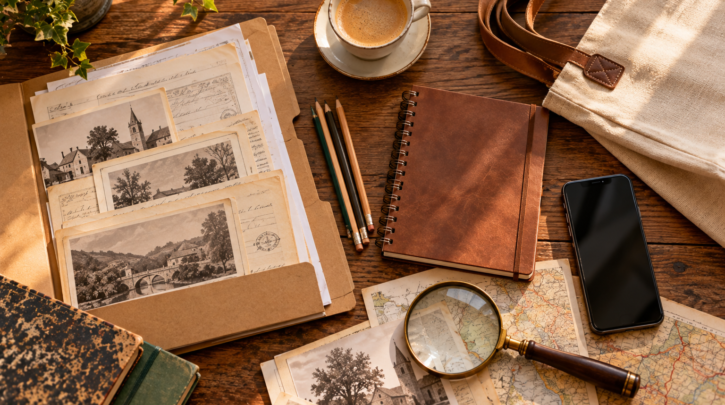

A visit to a French archive can be a highlight of a heritage trip, or a frustrating morning of being turned away at the door. The difference is usually preparation. This checklist covers what to bring, what to leave behind, and the rules you will meet in most French reading rooms.
The essentials
| Bring | Why |
|---|---|
| Passport or photo ID | A reader’s card is issued free on presentation of an identity document, including to foreign visitors |
| Pencils and an eraser | Pencil is generally the only writing tool allowed in the reading room; pens are prohibited to protect documents |
| Paper or a notebook | Loose paper and notebooks are normally permitted; check the rules for any restrictions |
| Your research list | Commune, years, names, and reference numbers (cotes), so you do not waste reading-room time |
| A copy of your family tree | It helps you check each act against what you know |
| A camera or phone | Many reading rooms allow personal photography without flash, but rules vary, so ask |
| A laptop or tablet | Often allowed for note-taking; check the rules and keep it silent |
Before you go: check the archive’s website
- Opening days and hours. They vary by archive and may include closures for holidays and staff training.
- Registration. Some archives allow or require pre-registration online. Others register you at the desk.
- Document ordering. Some archives let you reserve documents in advance, which can save time, while others deliver at the desk.
- Digitized registers. If your commune’s registers are online, you may be able to do part of the research at home first. See our archives guide.
- Rules for photography and copies. They differ between archives.
Prepare your research list
- List the commune and the years for each event you want to see.
- Start with the ten-year indexes (tables décennales) for the relevant decades to find act numbers.
- Note the reference numbers (cotes) of each register from the archive’s online catalog.
- Prioritize. Put the most important acts first in case you run short of time.
- Bring extra years. If an act is missing, check neighboring years and communes.
What to expect in the reading room
- A free reader’s card, issued at the desk on first registration, usually valid for a year.
- Silence. Reading rooms are quiet places. Phone calls take place outside.
- Pencil only. Pens are prohibited, and some objects may not be brought in at all.
- Lockers or a cloakroom. Bags, coats, and large items are generally left outside the reading room.
- Documents delivered at the desk. You collect them and return them there, and you may be limited in how many you can have at once.
- Care with the originals. Handle documents gently, keep them flat, and do not write on them or mark them.
What to leave at home or in the locker
- Pens, markers, and highlighters.
- Food and drink, which are not permitted near documents.
- Large bags and anything that could damage documents, such as scissors or adhesive notes.
- Anything noisy or distracting.
A few practical tips
- Arrive early. Good seats and ordering windows fill up.
- Check lunch hours. Some reading rooms close at midday, or stop delivering documents before closing.
- Learn the key words. See French phrases for a genealogy trip and our guide to reading old French records.
- Photograph every act you use where permitted, and note the register and image number.
- Be polite and patient. The staff are knowledgeable, and a friendly question often saves hours.
If you cannot travel
You can often get what you need without visiting. Many archives publish registers online, and most will answer a short written request, as described in our guide to writing to a French mairie. Some offer reproduction services for a fee, and local genealogy societies sometimes help with look-ups. Check each archive’s website for how to request copies from abroad, and use the FranceArchives portal to find the right institution.
If you are visiting the national archives
The Archives nationales have their own procedures, including a free annual reader’s card on presentation of ID and separate sites for different record types. See our guide to the Archives nationales in Paris and the Archives nationales website.
After the visit
- Transcribe the acts you photographed while the details are fresh.
- Cite the archive, the register, and the image number for every fact.
- Update your tree, and note the questions the new acts raise.
- Plan the next step, whether another archive, a village visit, or a letter to the mairie. See our guide to visiting your ancestral village.
Illustrative composite (not a real family): A researcher from British Columbia arrives at a departmental archive with her passport, three sharpened pencils, and a one-page list of act numbers drawn from the ten-year indexes she consulted online with a name index on MyHeritage. She is registered in ten minutes, leaves her bag in a locker, and has read five registers by closing time.
For the overall research method, return to our complete guide to tracing French ancestry, or see our sample itinerary.
Common mistakes to avoid
- Arriving without references. Without the commune, years, and reference numbers, you will spend hours finding what a catalog could have told you.
- Arriving on a closed day. Check the calendar for holidays and closures.
- Bringing a pen. It will be taken away, and you will lose time.
- Ordering too late. Documents can take time to bring to the reading room.
- Skipping the photographs. If photography is permitted, capture each act and note its reference at once.
Questions the archive staff can answer
- Which registers cover my commune and years, and which are digitized?
- Are there indexes or finding aids for my family’s surname?
- What is the limit on documents I can order at one time?
- Are there rules about photography, laptops, or copies?
- Is there a nearby cercle généalogique (genealogy society) that could help?
For official background, see FranceArchives and our French genealogy records hub.
French Roots is reader-supported. Some links on this page are affiliate links, which means we may earn a commission if you sign up, at no extra cost to you. Read our affiliate disclosure.