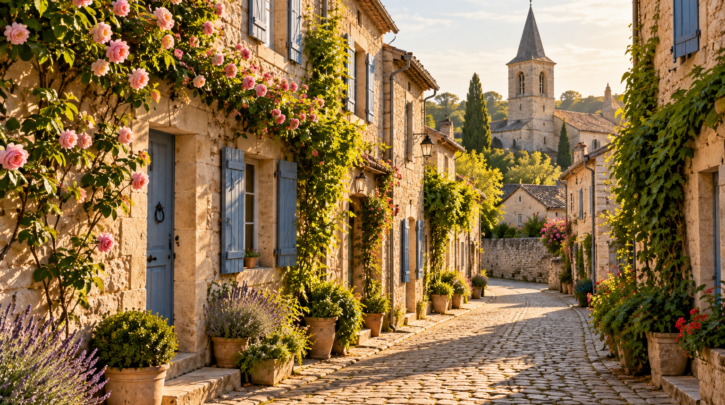

Standing in the village where your great-grandparents were born is one of the most moving things a family historian can do. It is also easy to get wrong. Villages are small, offices have short hours, cemeteries change, and a trip planned around guesses can end at a locked door. This guide explains how to prepare, what to look for once you arrive, and how to make a visit to your ancestral village in France meaningful rather than frustrating.
Before you book anything: do the research first
A heritage trip works best when you already know the facts. You should arrive with the name of the commune and département, the names and dates of the ancestors who lived there, and, ideally, copies of their birth, marriage, and death acts. If you do not yet have a commune, start with our guide to finding your ancestor’s commune of origin and our complete guide to tracing French ancestry, and complete the records work before you travel. A name index such as the one on MyHeritage, drawn from Filae, can confirm an ancestor’s commune and dates before you commit to a trip.
Find the exact places, not just the village
Records often name a hamlet or farm (lieu-dit), not only the commune. Before you go, try to pin down where your family actually lived:
- Modern and historical maps. Géoportail is the official French mapping portal and lets you locate a commune, a hamlet, or a plot and overlay older layers such as the Napoleonic cadastre and the Cassini maps. IGN’s “Remonter le temps” tool compares old and new aerial views.
- The cadastre. The early nineteenth-century land survey shows the layout of the village, the church, and the cemetery, and lists owners. Many departmental archives publish it online. See our archives guide.
- Addresses in the acts. Birth, marriage, and death acts often give a residence. Note every place name, with its spelling.
- Old photographs and postcards. Local history groups and online collections often show how the village looked.
Contact the mairie before you arrive
The town hall (mairie) is your first stop and often your best source. In small communes, the office may be open only a few half-days a week and staffed by a single secretary, so a surprise visit can fail. Write or email ahead, say who you are and what you hope to see, and ask when you could come. Our guide to writing to a French mairie includes model letters in French and English. Ask whether the commune has a cemetery plan, whether a local history or genealogy society exists, and whether anyone can show you the church.
What to see in the village
- The church. Your ancestors were baptized, married, and buried from it for centuries. Look for plaques, stained-glass donors, and family names in the building.
- The mairie. Beyond the registers, many town halls hold local photographs and the commune’s history.
- The war memorial. Almost every commune has a monument aux morts listing the names of men lost in the world wars. A family surname there can tell you who stayed and who served.
- Houses and farms. Compare what you see with the cadastre and old postcards, and photograph the setting from the road.
- A local museum or history association. Volunteers often know families, farms, and nicknames that no database records.
The cemetery: manage your expectations
Many visitors hope to find a family grave, and some do. But French cemetery law means a grave may no longer exist. Temporary and thirty-year concessions can expire, and perpetual concessions that have been abandoned can be reclaimed by the commune after a formal procedure, with the remains moved to an ossuary. Some villages also moved their cemetery long ago. As a result, an ancestor may be commemorated only in the burial register.
- Ask the mairie whether a cemetery plan or concession register exists, and whether it lists past concessions.
- Look for free photographic projects such as Geneanet’s “Sauvons nos tombes,” which document cemeteries and may already show your family’s stones.
- Treat graves with respect: do not move objects, and avoid harsh cleaning, which can damage old stone.
- If you find nothing, check the burial act in the registers. It records where and when the ancestor died.
Combine the village with the archives
The departmental archives hold the original registers, usually in the département’s main town, so most heritage trips combine a village day with an archive day. See our checklist for visiting French archives. If your research touches national records, our guide to the Archives nationales in Paris explains what is there.
Practical logistics
- Transport. Rural communes are often poorly served by public transport, so many visitors rent a car for the village days.
- Timing. Offices keep short hours, close at lunch, and may have reduced service in holiday periods. Confirm days and times in writing.
- Accommodation. Small towns near the village often have guesthouses and country rentals, which suit a base of several nights.
- Language. A few French phrases go a long way. See French phrases for a genealogy trip.
- Planning. Use our sample seven-day itinerary as a starting point.
Meeting people with courtesy
Start every conversation with “Bonjour,” introduce yourself, and say plainly why you are there. Be humble about your French and generous with what you know: bring a short family tree and a few photographs, which often open doors. Villagers may remember a family name, a farm, or a cousin who stayed behind. Offer to share what you find, and thank people in writing afterward.
If the village has changed
- Mergers and renamings. Many communes have merged with neighbors, and some have changed name. The archives and the mairie can tell you the current name for the old one.
- War damage. Parts of France, such as Normandy in 1944, lost buildings, and some villages look quite different from old photographs.
- Border regions. In Alsace and Moselle, place names appear in both French and German. See our Alsace-Lorraine guide.
Before you go: a checklist
- Confirm the commune, the département, and the ancestors’ names and dates.
- Gather copies of the key acts and a short family tree.
- Locate the village, hamlet, and cemetery on a map, and note old layouts.
- Write to the mairie and fix a date and time.
- Plan the archive day and check the reading room’s rules.
- Learn a handful of French phrases and bring a notebook and a camera.
- Allow slack: expect closed doors, short hours, and unexpected discoveries.
Illustrative composite (not a real family): A family from Ohio traces their great-grandfather to a hamlet near Épinal. They write to the mairie in the spring and are invited on a Thursday afternoon. The secretary shows them the commune’s cemetery plan and introduces them to a retired farmer who remembers the family’s farm. The next day, in the departmental archives, they read the birth register and photograph the act.
For the broader picture of French regions, see our guide to French regions, and for background on archives and places, the FamilySearch Research Wiki on France and FranceArchives.
What to bring on the day
- Copies of the key acts and a one-page family tree, in a folder you can hand to someone.
- A few old photographs, which prompt memories and show you are serious.
- A notebook and pencil, and a camera or phone for the village, the church, and the cemetery.
- A printed map with the commune, the hamlet, and the cemetery marked, in case your phone has no signal.
- Small gifts or thanks, such as a postcard from your home town, for people who give you their time.
Questions to ask at the mairie and in the village
- Does the commune have a cemetery plan or a register of concessions?
- Is there a local history or genealogy association, and who is its contact?
- Do families with our surname still live nearby, or is there a farm or house associated with the name?
- May I see the church, and who holds the key?
- Are there old photographs, newsletters, or a village history I could look at?
After the visit: keep the connection
Send a thank-you note to the mairie and anyone who helped, with a copy of any photographs you took of them or their village. Transcribe your notes while the details are fresh, and file photographs with the place and date. If you met a historian or a cousin, keep in touch, because French villages hold long memories and the best leads often arrive months later in a letter. If you found a connection, confirm it in the registers, and consider the DNA options in our DNA hub.
French Roots is reader-supported. Some links on this page are affiliate links, which means we may earn a commission if you sign up, at no extra cost to you. Read our affiliate disclosure.