
“They changed our name at Ellis Island.” Nearly every family with immigrant roots has heard that sentence. For French families it is usually wrong, and the truth is more useful to a researcher. Names did change, often dramatically, but they changed in particular ways and at particular moments, each of which leaves a trail. This guide explains what really happened to French surnames in America and how to follow the trail back.
The Ellis Island myth
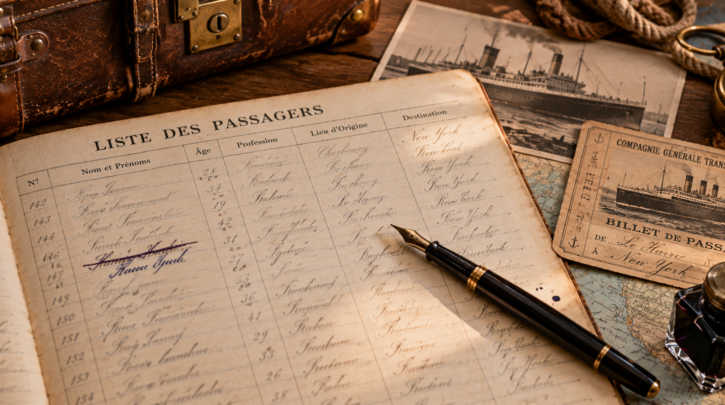
Immigration inspectors at Ellis Island did not write down names. The passenger lists were prepared at the port of departure, usually by shipping-company clerks, and the inspectors checked arrivals against those lists. For French emigrants, the lists were often drawn up at Le Havre. Historians and archivists agree that no names were changed at the inspection desk, and the story appears to have spread widely only in the late twentieth century. The article Debunking an Immigration Myth sets out the evidence.
This matters for research. If the name on the manifest differs from the name your family later used, the change happened somewhere else, and the manifest is likely to give the name as spelled in France.
How French names really changed
- The family changed it. Immigrants simplified, anglicized, or translated their names to fit in, find work, or avoid prejudice, often within a few years of arrival.
- Clerks and neighbors changed it. Census takers, employers, teachers, and priests wrote names as they heard them, and the new spellings stuck.
- A court changed it. Some people formally changed their names when they naturalized, and courts recorded both the old and the new form.
- Language did it. In regions where families moved between French and English, spellings shifted with the language of the record. American Ancestors describes how French-Canadian names in Vermont changed this way in The Name DID Change.
Types of change, with examples
| Type of change | Example |
|---|---|
| Spelling simplified or respelled by sound | Pelletier became Peltier and, in parts of New England, Pelkey; Lavoie became Lavoy |
| Translated into English | Leblanc became White; Lenoir became Black; Lebrun became Brown; Dubois became Woods; Boulanger became Baker; Charpentier became Carpenter; Lacroix became Cross |
| Partly anglicized | Rivoire became Revere; Baudouin became Bowdoin |
| Accents and particles dropped | Lévesque became Levesque; De La Croix became Delacroix |
These are patterns seen in records, not rules. Each family’s change must be proven, and the same French name could end up in several different English forms in different branches.
When did the change happen?
Often later than people think. Many families kept the French form through the first generation and changed it in the second, when children entered English-language schools and workplaces. The change may appear first in a census or a draft card, then in a death record. Look at the whole life of the family rather than a single document.
How to trace an anglicized French surname
- Start with the earliest American record. The passenger manifest and naturalization papers usually carry the most original spelling.
- Collect every version. List the name as it appears in census, church, military, and vital records.
- Check French-language sources. French-speaking parishes often recorded names in their original form longer than civil offices did.
- Try translations. If the name looks like an English word, consider whether it is a translation of a French one, such as Baker for Boulanger.
- Search both forms across the records. Add the English and the suspected French forms to your search on MyHeritage or any index. See our spelling variants guide.
- Go to the commune. Once you have a French spelling and a place, confirm in the registers. See our guide to finding the commune.
A special case: French Canadians
French-Canadian families who crossed into the United States, especially New England, changed names so often that the variants fill genealogy articles. If your ancestors came through Quebec, see our sister site French Canadian Roots.
Do not “restore” a name without proof
It is tempting to assume that an English name is a translation and to invent a French original. Resist. A name like Black may be an English name that has nothing to do with Lenoir. Treat any proposed original as a hypothesis until a record links the two.
Illustrative composite (not a real family): A family in Vermont has the surname Pelkey, and a story that it was changed at Ellis Island. Their earliest American record, a church baptism, gives the name as Pelletier, and the naturalization paper of the immigrant gives a birthplace in Normandy. The name was respelled over two generations, and the French original was recoverable.
For the broader research method, see our complete guide to French surname origins and our guide to tracing French ancestry.
Records where two forms of the name appear together
The best evidence of a name change is a record that shows both forms. Look for naturalization petitions that list the name as spelled in the old country alongside the name used now, church records where a priest recorded the French form while the civil record shows the English, and family documents such as baptism certificates sent from France. Obituaries and death certificates sometimes give a father’s name in the original spelling even when the family used another.
Family stories versus evidence
Family stories about names are valuable clues, but they are not evidence. A story that “the name was changed at Ellis Island” points to a real change that happened somewhere. Treat it as a prompt to examine the family’s records and find where the spelling shifts, not as an answer. Writing down the story, then testing it against the passenger list, the first census, and the naturalization papers, turns a legend into a research plan.
Where French families left the clearest trails
- French-language parish registers in Louisiana, the Midwest, and New England often preserved original spellings for years.
- Naturalization papers name the birthplace and sometimes the original spelling.
- Ship manifests from Le Havre and other ports show the name as written in France.
- The commune’s own registers in France, which show the name as the family used it before leaving. See our état civil guide.
French Roots is reader-supported. Some links on this page are affiliate links, which means we may earn a commission if you sign up, at no extra cost to you. Read our affiliate disclosure.