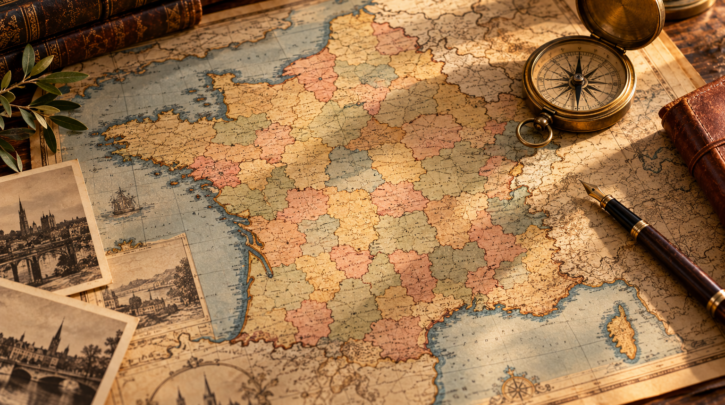

Ask a French genealogist where a family comes from and the first answer is rarely a village. It is a region. Brittany, Normandy, Alsace, the Basque Country, the Cévennes: each carries its own language, surnames, religious history, and record quirks, and knowing which one your ancestors belonged to tells you where to look, what to expect, and which pitfalls to avoid. This guide explains how French geography is layered, why it matters for research, and how the main regions differ.
Three layers of French geography
French researchers constantly meet three overlapping maps, and it helps to keep them apart:
| Layer | What it is | Why it matters to you |
|---|---|---|
| Historic provinces | The old kingdom’s regions, such as Brittany, Normandy, Alsace, and Poitou, which lasted until 1789 | Surnames, dialects, customs, and religion follow the provinces; most older family stories refer to them |
| Départements | Administrative units created in 1790 (83 at first, now 96 in metropolitan France plus 5 overseas) | Records are organized by département. Each département’s archives hold the registers for its communes |
| Modern regions | Larger groupings created in 1982 and reorganized in 2016 (13 in metropolitan France) | Mostly administrative; useful for navigation but a poor guide to ancestry |
The practical rule: identify the commune, find its département, and let the historic province tell you what kind of family and records to expect. Our guide to finding your ancestor’s commune of origin covers the first step.
Why region matters for your research
- Where the records live. A département’s archives hold the civil and parish registers for every commune inside it, so the département decides which website you use. See our guide to the archives.
- Language and spelling. Breton, Basque, Occitan, and the Germanic dialects of Alsace and Moselle all shaped how names were spoken and then written down by clerks who may have spoken another language.
- Religion. Protestant strongholds in the west and south left different records from Catholic regions, and the Huguenot story is largely a regional one.
- Borders and wars. Alsace and part of Lorraine belonged to Germany from 1871 to 1918, which changed the language of the records, and 1944 reshaped parts of Normandy.
- Migration patterns. Some regions sent large numbers of emigrants and others very few. Knowing the pattern helps you guess where relatives went.
A genealogist’s map of the main regions
| Province or area | Today’s départements | What to know |
|---|---|---|
| Brittany (Bretagne) | Finistère, Côtes-d’Armor, Morbihan, Ille-et-Vilaine; historically also Loire-Atlantique | Breton language in the west; very distinctive, heavily repeated surnames |
| Normandy (Normandie) | Calvados, Eure, Manche, Orne, Seine-Maritime | Viking-era roots; strong records; 1944 left a distinctive mark on the twentieth century |
| Alsace | Bas-Rhin, Haut-Rhin | German-language records from 1871 to 1918; large emigration to the Americas |
| Lorraine | Meurthe-et-Moselle, Meuse, Moselle, Vosges | Moselle was annexed with Alsace in 1871; mixed French and German records |
| Basque Country (French side) | Western Pyrénées-Atlantiques | Distinct language and naming traditions; notable emigration to the Americas |
| Île-de-France | Paris and the surrounding départements | Paris civil records were destroyed in 1871 and partly reconstructed; the capital drew migrants from every region |
| Poitou, Aunis and Saintonge | Vienne, Deux-Sèvres, Charente-Maritime, and part of Vendée | Protestant strongholds such as La Rochelle; ports that sent settlers overseas |
| Languedoc and the Cévennes | Gard, Lozère, and neighbors | A Protestant heartland with its own records and memory of persecution |
Regional notes and where to go deeper
Brittany
Brittany is the most distinctive of the western regions, with a Celtic language in the west and surnames that look unlike those of the rest of France. Read our guide to Breton ancestry.
Normandy
Normandy has excellent records, a Norse-influenced heritage, and a place in the story of the settlement of North America. See our guide to Norman ancestry.
Alsace and Lorraine
These border provinces changed hands more than once, and the records change language with them. Our guide to Alsace-Lorraine ancestry explains how to cope.
Protestant France and the Huguenots
If your family was Protestant, the regional picture matters even more. See our guide to Huguenot ancestry, and our history of French emigration to America for the broader story of who left and why.
Using surnames to narrow the region
French surnames are strongly regional. A name that is common in one département may be nearly absent elsewhere, and French genealogy sites offer tools that show where a surname is concentrated. Treat that as a clue rather than proof, since families moved, but when a surname clusters in one area it tells you which archives to try first and which spelling variants to expect.
Regions and DNA
DNA tests can suggest a broad region, but the boundaries are fuzzy and a result of “France” overlaps with neighboring countries. Use DNA to find cousins and confirm lines, not to name a village. Our DNA guide for French ancestry explains what to expect, including how French law affects the pool of French matches.
A practical workflow
- Find the commune in your North American records.
- Look up its département and historic province.
- Read the regional guide above to learn about language, religion, and special record issues.
- Open the département’s archive site and search the civil registers, then the parish registers.
- Add a name index such as the one on MyHeritage if you need to search across communes, and compare your options in our guide to French genealogy sites.
- Confirm every link in the records and cite your sources.
Illustrative composite (not a real family): A family in Wisconsin knows only that their ancestor was “from the Vosges.” Learning that the Vosges is a Lorraine département, they check whether the ancestor’s papers might name a German-era place name, find the commune, and open the right archive site, saving weeks of searching in the wrong place.
For the overall method, return to our complete guide to tracing French ancestry. For background on archives and regions, see FranceArchives and the FamilySearch Research Wiki on France.
Département numbers and why you will see them everywhere
When the départements were created, they were numbered alphabetically, and those numbers survive today in postal codes, archive catalogs, and genealogy websites. You will meet them constantly, for example 29 for Finistère, 14 for Calvados, 67 for Bas-Rhin, and 75 for Paris. Corsica is split into 2A and 2B. Knowing that a number refers to a département helps when a database asks you to “choose a département,” and it lets you spot at a glance which archive holds a record.
Languages and dialects you may meet
France has never been linguistically uniform, and the language of a region affects both names and handwriting. Besides Breton in the west and Basque in the southwest, you may meet Occitan across the south, Germanic dialects in Alsace and Moselle, Catalan in Roussillon, Flemish in the far north, Corsican on the island, and Franco-Provençal in the Alps. Civil and parish records were written in French (and Latin earlier), but a clerk who spoke another language at home may have spelled local names oddly, so expect variants and search by sound.
Other regions with special histories
- Savoy and Nice became part of France only in 1860, and before that belonged to the Kingdom of Sardinia, so older records there follow different rules.
- The far north (Flanders and Hainaut) was repeatedly fought over and has Flemish-influenced names and records.
- Corsica has its own naming traditions and a distinctive archival history.
- Roussillon in the southeast of the Pyrenees was Spanish until the seventeenth century, and has Catalan influences.
Regional genealogy societies
Almost every département has local genealogical societies (cercles généalogiques) whose volunteers transcribe registers, publish surname studies, and answer questions. The Fédération française de généalogie coordinates many of them. A short polite message in French, or in English with a few French phrases, often brings an answer a database cannot give, and local knowledge of nicknames, farms, and migration is difficult to find elsewhere.
Boundary changes that affect your records
Borders moved, and records moved with them. Alsace and part of Lorraine were German from 1871 to 1918, Savoy and Nice joined France in 1860, and communes within France have merged, split, or been renamed. Before you conclude that a record does not exist, check whether the place belonged to another jurisdiction at the time of the event, and whether the commune has changed name since. Archive websites usually list the current communes and, in many cases, note the former ones that were absorbed into them.
A final tip: keep a simple table of your family’s places with their historic province, current département, and any alternative names. It will save you from repeating searches, and it makes it easy to see how a family moved across regions over several generations.
French Roots is reader-supported. Some links on this page are affiliate links, which means we may earn a commission if you sign up, at no extra cost to you. Read our affiliate disclosure.