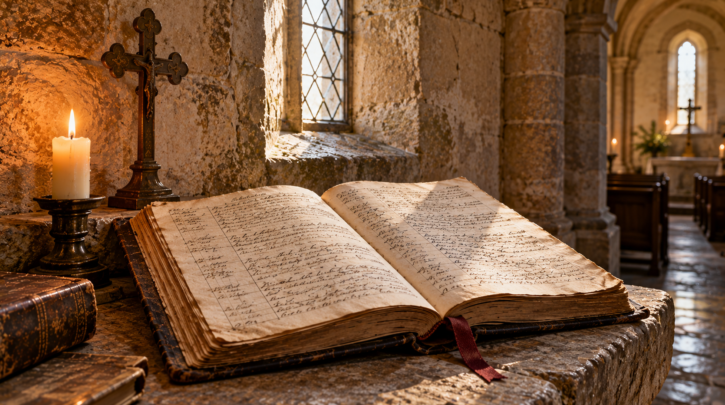

Before civil registration began in 1792, French families appear in the registers of their parish church. These registers of baptisms, marriages, and burials, known as BMS (baptêmes, mariages, sépultures), are your gateway to the 1600s and 1700s. They can be harder to read than civil records, but they are among the most continuous and widely digitized parish records in Europe.
How the registers came to exist
French kings required parishes to keep registers through a series of ordinances beginning in the sixteenth century, and from 1667 the registers were to be kept in two copies, one of which was deposited with the royal courts. That duplication is a major reason so many survive today, and it means that if one copy is damaged or missing, the other may fill the gap. In practice, quality varied widely by parish and period.
What the registers contain
| Entry | Typically records | Notes |
|---|---|---|
| Baptême (baptism) | Date, child’s name, parents, godparents (parrain and marraine), sometimes the father’s occupation and the birth date | Godparents were often relatives; they can reveal family links |
| Mariage (marriage) | Date, spouses, their parents, residences, witnesses, sometimes the banns and the consent of parents | A marriage often names both sets of parents |
| Sépulture (burial) | Date, name, often age and spouse | Earlier entries can be very short |
Early entries can be a single line, while many eighteenth-century entries are fuller. The same priest may spell a surname three different ways in a year, so search by sound as well as spelling.
What to expect when you read them
- Handwriting and abbreviations. Practice on a later register before attempting an earlier one. See our guide to reading old French records.
- Some Latin. Some regions and periods use Latin formulas, such as baptizatus (baptized) and sepultus (buried).
- Names. Women are listed under their maiden names, and many families reuse the same given names across generations, so confirm identity with dates and relatives.
- Dates. Entries record the date of the ceremony, which may be a day or more after the birth or death.
Protestant families and other non-Catholic records
The picture is more complicated for French Protestants (Huguenots). Records may exist in separate Reformed registers during periods of tolerance, but between the revocation of the Edict of Nantes in 1685 and the Edict of Tolerance in 1787, many Protestants appear in Catholic registers, or in clandestine registers kept by pastors. If your family was Protestant, look in both the Catholic and the Reformed registers, and expect gaps. Jewish records in this period are held mainly in separate community and notarial sources.
Gaps, fires, and reconstructions
Not everything survived. Registers were lost to fire, war, floods, and neglect, and one famous example is Paris, whose civil records were destroyed in 1871 and later partially reconstructed from other sources. When the register for your commune is missing for a year, check the duplicate copy, neighboring parishes, and notarial records, which may name the same families.
Where to find parish registers online
- The departmental archives hold the registers and, in most départements, publish digitized images for free. See our beginner’s guide.
- MyHeritage offers French church and civil records through its collections, including material from Filae, with a name index.
- FamilySearch has indexed some French church records and publishes a FamilySearch Research Wiki on France describing what exists for each region.
- Geneanet hosts indexes and user-contributed transcriptions for many parishes.
A practical method
- Start with the couple’s marriage, which names both sets of parents.
- Search for each spouse’s baptism a generation earlier, using the age at marriage to estimate the year.
- Check the godparents of each child for relatives, and use them to open new lines.
- Search the burial registers for parents and siblings to confirm the family group.
- Record the register, page, and image number so you can find the entry again.
Illustrative composite (not a real family): A researcher traces a marriage of 1884 back to an 1850s baptism in the same commune. The baptism names the godfather as the child’s grandfather, giving a surname and a village. Searching that village’s registers, she finds the grandfather’s own marriage in the 1810s and, through the parents named there, a baptism in the 1780s.
Parish registers connect the civil records to the seventeenth century, and the same method works at every step. For the civil period that comes just before, read our état civil guide, and for the overall method, return to our complete guide to tracing French ancestry.
Dealing with common problems
- The baptism is not where you expected. Children were often baptized in the mother’s parish, or a neighboring one, and a family could move between births. Search the surrounding parishes.
- The entry is very short. Early registers may give only a name and a date. Use the godparents, the witnesses at the family’s marriages, and notarial records to fill the gaps.
- Children born outside marriage and foundlings. Registers sometimes record a natural child (fils naturel) or an unknown father (père inconnu), and foundlings (enfants trouvés) may be recorded separately. These entries need careful reading, and the records are often held in separate hospital or departmental collections.
- Dating by feast days. A few entries refer to a feast day rather than a calendar date. Look up the feast in a liturgical calendar to find the date.
Keep a source log as you read
Parish registers reward careful notes. For every entry, record the parish, the register and year, the page or image number, and a transcription of the entry exactly as written, including the spelling. Note ages as given, remembering that eighteenth-century ages are often approximate. When two entries seem to describe the same person, write down why you think so, so that you can revisit the reasoning when new evidence turns up. A tidy log makes it easy to cite your tree and to share it with cousins.
How far back can you go?
Many parishes have continuous registers from the 1600s, and some are earlier, but coverage varies enormously by region and by the losses of war and neglect. Do not be discouraged if one line stops in the 1700s while another continues. When the registers run out, notarial records, tax rolls, and lord’s records (seigneurial archives) can sometimes carry a family further.
French Roots is reader-supported. Some links on this page are affiliate links, which means we may earn a commission if you sign up, at no extra cost to you. Read our affiliate disclosure.