
“He was from France.” Almost every family with French roots has a sentence like that, and almost every French research project stops there. The records on the other side of the ocean are organized by commune, so until you know the town or village, you cannot use them. This guide explains which records usually reveal the commune, how to read them, and what to do when the answer is vague or contradictory.
Why the commune matters so much
France has a few dozen thousand communes, and many share names. A birth was registered in the commune where it occurred, a marriage where the bride lived, and a death where the person died, so every civil and parish register belongs to one place. A surname alone is a needle in a very large haystack. A commune and a year, by contrast, take you directly to the page. Your goal is therefore to find the commune and its département, the region whose archives hold the registers.
The best sources for a French place of origin
Naturalization records
If your ancestor became a citizen of the United States, Canada, or another country, the paperwork is often the single best source. United States petitions for naturalization filed after 1906 generally record the place of birth, and declarations of intention often do too. Even when the form says only “France,” the supporting papers, witnesses, and the ancestor’s signature may point you toward a specific place.
Passenger and border-crossing records
Arrival manifests record who arrived, where they came from, and increasingly detailed information over time. Later lists, especially from the early twentieth century, often give a hometown or the name of a relative left behind, who may live in the same commune. Many French emigrants sailed from Le Havre, so the port itself is not a clue to the home village.
Draft registrations and military records
Draft registration cards and service records often give a place of birth, and some give the name of a nearest relative. They are especially useful for men who arrived as young adults.
Vital records of the immigrant and his children
Check the death certificate of the immigrant, the marriage records of his children, and the birth records of his grandchildren. Informants often supplied the parents’ birthplace and sometimes a town. Death records are especially valuable because the informant was usually a close relative, though informants could be mistaken, so look for agreement across several documents.
Church records
A parish in the new country may record a baptism or marriage and the origin of newcomers. French-language parishes, in particular, often described a groom as “native of” a French place.
Passport applications, obituaries, and family papers
Passport applications, obituaries, funeral cards, photographs from studios in a French town, letters with a return address, and family bibles can all name a place. Ask relatives to search attics and drawers. A single postcard postmark has solved more than one French research problem.
DNA
DNA matches cannot name a commune, but a cluster of cousins with ancestors in the same French region can confirm that you are looking in the right area. See our DNA guide for French ancestry.
When the answer is vague or wrong
- Different records, different places. A person may name a birthplace, a last residence, and a port of departure. The birthplace is what you need. If records disagree, record every version.
- Spelling drift. Clerks wrote what they heard. A commune might appear with a different spelling, a missing accent, or an English phonetic version, so check a gazetteer and map.
- Duplicate names. Many communes share a name. Use the département, neighboring places, and the surname’s regional distribution to decide between them.
- Changed boundaries and names. Communes have merged and some have been renamed. Alsace and part of Lorraine belonged to Germany from 1871 to 1918, and their registers from that period are in German.
- Only a region. If you know a département or province but not a commune, search for siblings, the parents’ names in a marriage, and family trees on MyHeritage and Geneanet.
Illustrative composite (not a real family): A family in Michigan knows only that their ancestor “came from Normandy.” His World War I draft card gives a birthplace that matches no commune they can find. Checking a gazetteer, they discover the village was renamed after a merger. The old name appears on the departmental archives site, and the birth register was one click away.
Once you have the commune
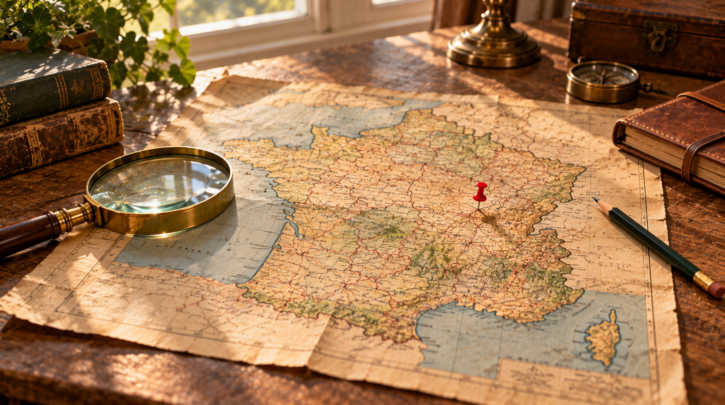
Locate it on a map, identify its département, and search the civil registers. Our état civil guide explains what you will find, and our guide to the departmental archives shows how to navigate the site. If you want to search a name across many communes at once, MyHeritage’s French record collections, drawn largely from Filae, make that possible. Compare your options in our guide to French genealogy websites.
For the overall research path, return to our complete guide to tracing French ancestry.
Questions to ask your relatives
Before you spend a dollar on records, talk to the oldest people in your family. Memories fade quickly, and a single detail can save weeks of searching. Useful questions include:
- Where did the family say they came from, even loosely, such as a region, a river, or a nearby city?
- What was the immigrant’s trade, and did he or she send or receive letters from France?
- Does anyone have old postcards, photographs with a studio stamp, or a passport?
- Were there relatives who stayed in France, and did anyone visit them?
- What language was spoken at home, and did the family use any regional words?
- Which church did the family attend, and are baptism or marriage certificates kept at home?
Using maps and gazetteers
When a record gives a place name you cannot find, check it against several sources: a modern map, a historical gazetteer, and the lists of communes on the departmental archives sites. Many communes have merged with their neighbors or been renamed, and a hamlet (lieu-dit) may be recorded in place of the commune itself. The FamilySearch Research Wiki on France explains how to locate French places and identify the right administrative divisions. Keep a note of every variant spelling you find, because the one that finally matches an archive catalog is often not the one in your family stories.
French Roots is reader-supported. Some links on this page are affiliate links, which means we may earn a commission if you sign up, at no extra cost to you. Read our affiliate disclosure.